Queer Places:
Friedhof St. Matthias, Röblingstraße 91, 12105 Berlin-Bezirk Tempelhof-Schöneberg, Germany
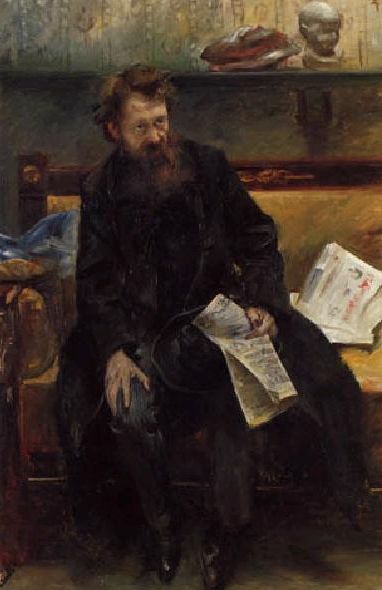 Peter Hille (September 11, 1854 - May 7, 1904) was born on September 11, 1854, in Erwitzen (near Höxter), Germany, into the family of a schoolteacher. He attended gymnasiums
in Höxter and Münster. During his school years, he joined Satrebil, a secret youth union where members studied radical political and philosophical texts by Karl Marx,
Charles Darwin, Pierre-Joseph Proudhon, and August Bebel. In 1874, Hille was
expelled from the gymnasium due to poor academic performance. Following his expulsion, he briefly worked as a clerk for a prosecutor in Höxter and later as a proofreader in
a Leipzig printing house.
Peter Hille (September 11, 1854 - May 7, 1904) was born on September 11, 1854, in Erwitzen (near Höxter), Germany, into the family of a schoolteacher. He attended gymnasiums
in Höxter and Münster. During his school years, he joined Satrebil, a secret youth union where members studied radical political and philosophical texts by Karl Marx,
Charles Darwin, Pierre-Joseph Proudhon, and August Bebel. In 1874, Hille was
expelled from the gymnasium due to poor academic performance. Following his expulsion, he briefly worked as a clerk for a prosecutor in Höxter and later as a proofreader in
a Leipzig printing house.
Hille began his literary career in the late 1870s, contributing poems and literary criticism to publications such as Deutsche Dichtung and Deutsche Monatsblätter. He also
worked briefly for the socialist newspaper Bremer Tageblatt.
In 1880, Hille lived in London under modest circumstances, deepening his studies in socialism and anarchism. Sometime later, after receiving an inheritance, he financed a
Dutch theater troupe—a venture that failed and left him financially ruined. This marked the beginning of an intensely transient, bohemian lifestyle; Hille spent long periods
living in extreme poverty, often homeless or working as a wandering tramp, while remaining deeply committed to literature.
In 1888, Hille contracted tuberculosis. Despite his failing health, he became an influential figure in the development of German naturalism. Assisted by writer Karl
Henckel, Hille traveled to Zurich and later through southern Europe. In 1891, he lived with his friend, writer Julius Hart. Because
authorities viewed him as a dangerous socialist agitator, Hille faced continuous police surveillance and moved frequently to avoid arrest before finally settling in Berlin
in 1895.
In Berlin, Hille became a central, almost mythical mentor figure within the city’s avant-garde and naturalist circles, including the Friedrichshagen poets' circle. He was
heavily involved with the Neue Gemeinschaft (New Community), an idealistic, anarchist-leaning bohemian group that brought together progressive artists, writers, and social
reformers.
In 1902, with financial backing from supporters, Hille opened the Cabaret zum Peter Hille, where he staged high-caliber literary and musical performances alongside
prominent figures such as Else Lasker-Schüler, Erich Mühsam, Richard Dehmel, and Otto Julius Bierbaum.
Hille published novels and plays, including Die Sozialisten (1886), Des Platonikers Sohn (1896), and Semiramis – Cleopatra (1902). He died of tuberculosis on May 7, 1904,
in Groß-Lichterfelde near Berlin, at the age of 49.
While Peter Hille's own primary historical footprint is rooted in naturalism, socialism, and turn-of-the-century Berlin bohemia, his life and artistic circles intersect
significantly with early queer history and the nascent homosexual emancipation movement in Germany:
Hille was a central guiding figure in the Neue Gemeinschaft, a radical, alternative community in Berlin. This circle shared close intellectual and social overlaps with
early pioneers of gay rights. Notably, sexologist Magnus Hirschfeld—who founded the Scientific-Humanitarian Committee in 1897
as the world's first homosexual rights organization—was associated with the Neue Gemeinschaft network and published works documenting Berlin's diverse subcultures (such as
Berlin's Third Sex) alongside peers in Hille's broader milieu.
The expressionist poet and playwright Else Lasker-Schüler was one of Hille's closest protégées and most devoted admirers, famously portraying him as a king-like,
prophetic figure in her prose. Lasker-Schüler's life and work pushed boundaries regarding fluid gender expression, cross-dressing, and non-conforming sexual and romantic
identities within Berlin's avant-garde.
Hille’s rejection of bourgeois lifestyle norms, traditional marriage structures, and conventional morality created space for the radical acceptance of alternative
subcultures. His inner circle included anarchists, socialists, and free-thinkers who challenged traditional 19th-century frameworks of gender, sex, and society, paving the
way for Weimar-era sexual reform.
References:
- Lexikon Westfälischer Autorinnen und Autoren: Regional biographical documentation on Peter Hille's early life, family background, and education in Westphalia.
- Deutsche Biographie (Bayerische Staatsbibliothek / Historische Kommission bei der Bayerischen Akademie der Wissenschaften): Comprehensive scholarly biography detailing Hille’s genealogy, wanderings, political surveillance, and literary output (including Die Sozialisten and Des Platonikers Sohn).
- Rüdiger Bernhardt, "Ich bestimme mich selbst": das traurige Leben des glücklichen Peter Hille (1854-1904) (Jena: Bussert & Stadeler, 2004): A foundational modern biographical study of Hille's life, mindset, and bohemian trajectory.
- Else Lasker-Schüler, Das Peter Hille-Buch (1906): Memoirs and sketches written by Hille’s close friend and protégé, capturing his life, philosophy, and central presence in Berlin’s avant-garde circles.
- Archival and Cultural History on Neue Gemeinschaft and Early Berlin Bohemia: Research regarding turn-of-the-century alternative communities in Berlin detailing the network overlaps between Peter Hille's intellectual circle, sexologist Magnus Hirschfeld, and early proponents of sexual and social reform.
Support this project
This website is a passion project researched, developed, and funded entirely by me. If you find the content valuable and would like to help support the ongoing research and hosting costs, any contribution is deeply appreciated.
Thank you for keeping this independent resource alive!
My books on Amazon: Elisa Rolle's books
BACK TO HOME PAGE